

How To Answer Short-answer Questions and Structured Questions in IGCSE Physics 0625
The short-answer questions and structured questions on Papers 3 (Core) and 4 (Extended) are designed to test the candidate’s knowledge and understanding of physics theory and the ability to apply the knowledge to situations described on the paper. This article includes tips on how to read the questions and advice in particular items.
Basic Guidelines:
- Be at ease in using your calculator. We suggest that you get familiar with it and its features.
- Do not repeat any facts given in the question set. You must answer the questions directly.
- If you’re having trouble answering a question, leave it first and come back to it later. Put a mark by the side of the question so you can find it easily.
- Do not waste time and write a long answer to a question which has one or two marks. You will not gain extra marks even if your answer is full of many correct and relevant statements.
- The number of marks will guide you on how long to spend on each question or parts of a question.
- If a part of the question is worth three marks you should make at least three separate points. Be careful not to make the same point three times - no marks are awarded for the repeated points.
- When drawing diagrams, you must draw it with a ruler and label it with straight lines.
Read the whole question carefully and fully
Read the question once right through and then again more slowly. It is best to highlight the main features of a question by underlining or circling the keywords in the question. This will help you decide which area of physics is being asked. Any explanation of the relevant physics statement that does not answer the question set will not earn marks.
The questions usually include stimulus materials that contain all the relevant information. The information can be given in different ways: a diagram, a graph or a table. Study the materials thoroughly as they often provide clues and answers to the question. Read the introductory sentences as it often includes information that is required in your answer.
Be familiar with the Command Words
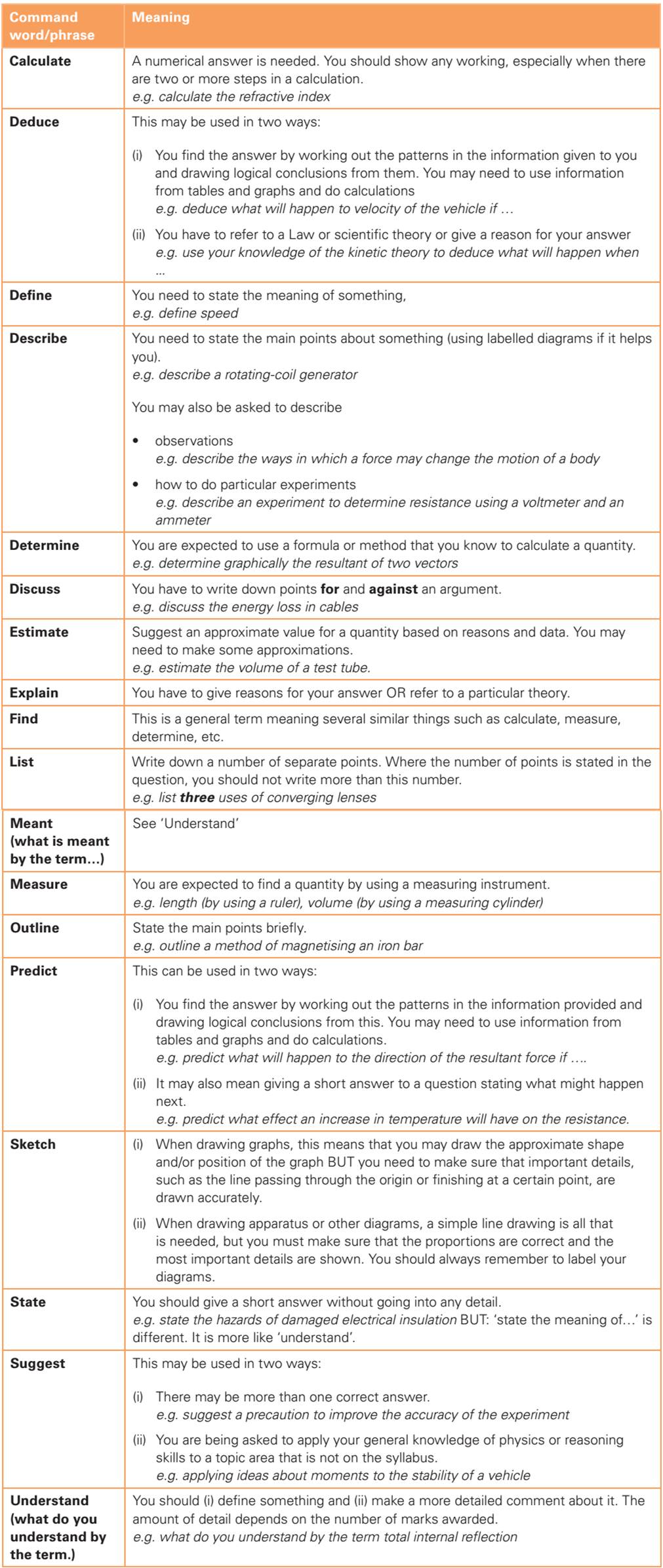
Command words aim to guide the candidates in providing the right response to each question. It is best to review each of these phrases and words to understand the meaning of a term. A table of command words and its brief definition are listed below. However, the meaning of a term may vary slightly according to how the question is worded.
When answering calculation, always show the working of your answer
All science papers include calculations. You should learn a set method for solving a calculation and use that method. You must write out all the working for your calculation as it can gain marks for the method even if there’s a mistake with the final answer. For example, if there are three marks available for a calculation, two of the three marks are for showing the proper method of calculation.
Some questions require you to carry out the calculation and add the result to a table. In these cases, your answer must be the same way as the figures are given. Be consistent with your final answers. If the figures are 5.63 and 4.65, then the answer should be given to two decimal places. Even if the answer is a whole number, the answer should be written as 7.00, not 7. When using a calculator, round up or down the figures – don’t copy all the figures after the decimal point.
Remember to write the correct symbols and units
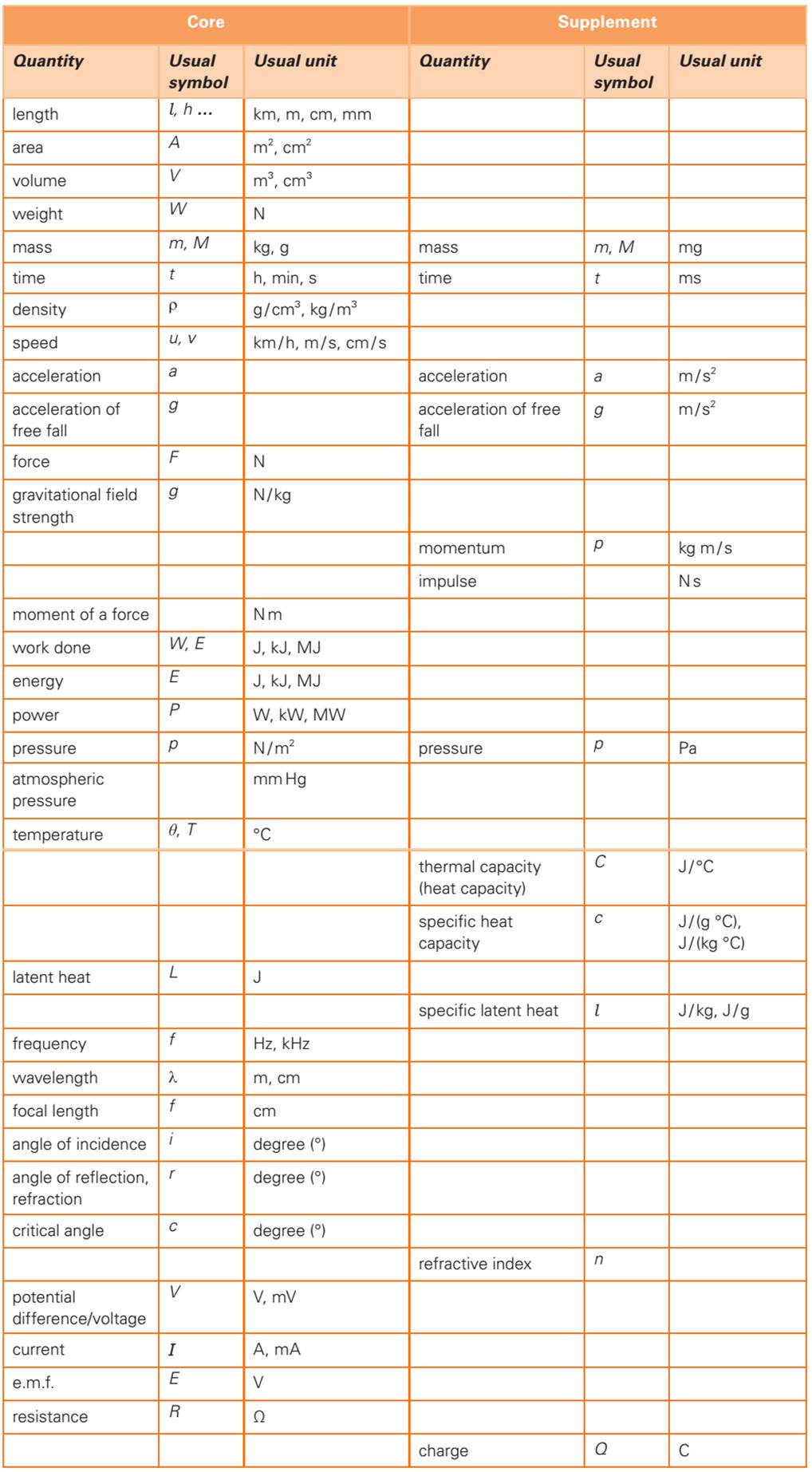
Candidates must be able to state symbols for the different physical quantities and, where indicated, state the units in which they are measured. The table below lists the quantity, the usual symbol and usual unit used in Physics syllabus.
Familiarise with the following multipliers: M mega, k kilo, c centi, m milli as these may be included in many calculations. Make sure to show the units in the calculation. If the units are not given on the answer line, then always write them after the numerical answer.
* Note: All relevant info taken from CIE.
2 Comments on How To Answer Short-answer Questions and Structured Questions in IGCSE Physics 0625